
Chita Project: Development and Chronology
Introduction
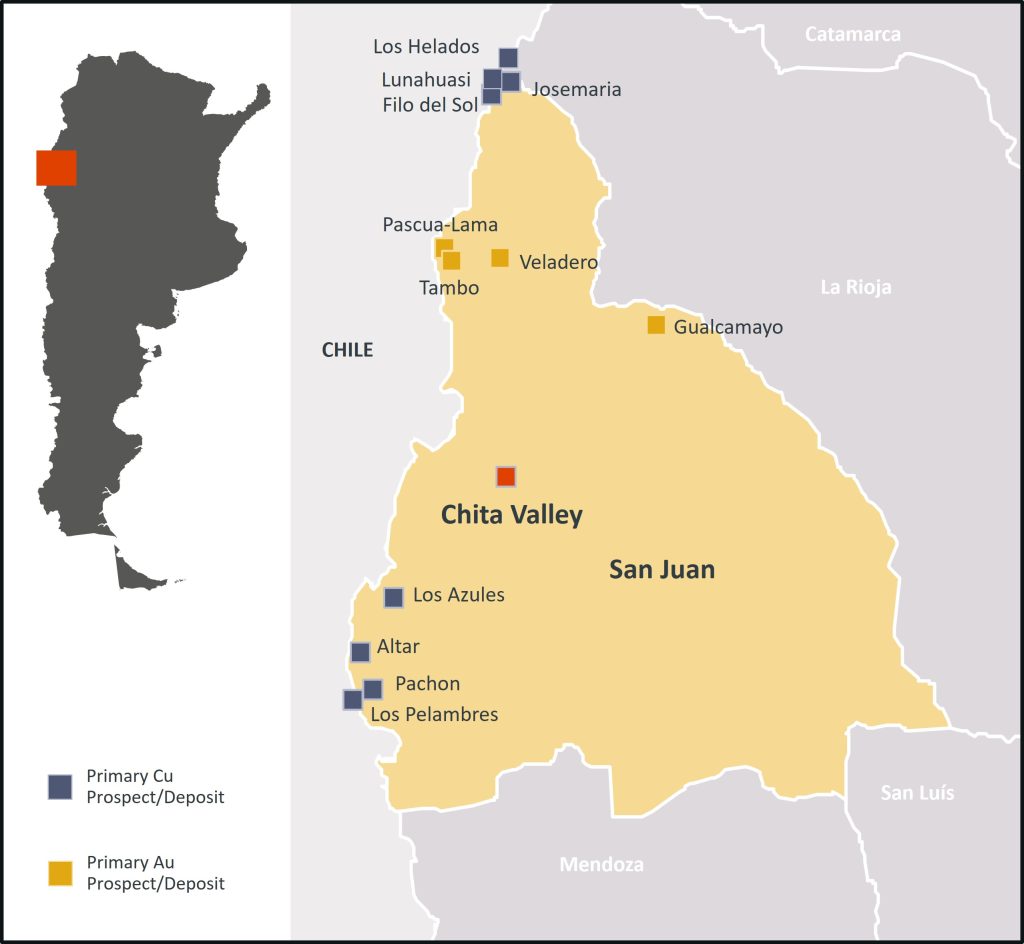
The Chita Project⠀is located in the mining province of San Juan, Argentina, within a prospective belt, with several copper and gold deposits. Within the property we have the Chita tank, historically defined by its copper resource, and more recently a new discovery related to the Chinchillones polymetallic tank has been identified.
Our projects
PSU:
- Enrichment zone on copper mineralization nucleo, within the porphyte-type system.
- Calcosine enrichment mantle, leachable.
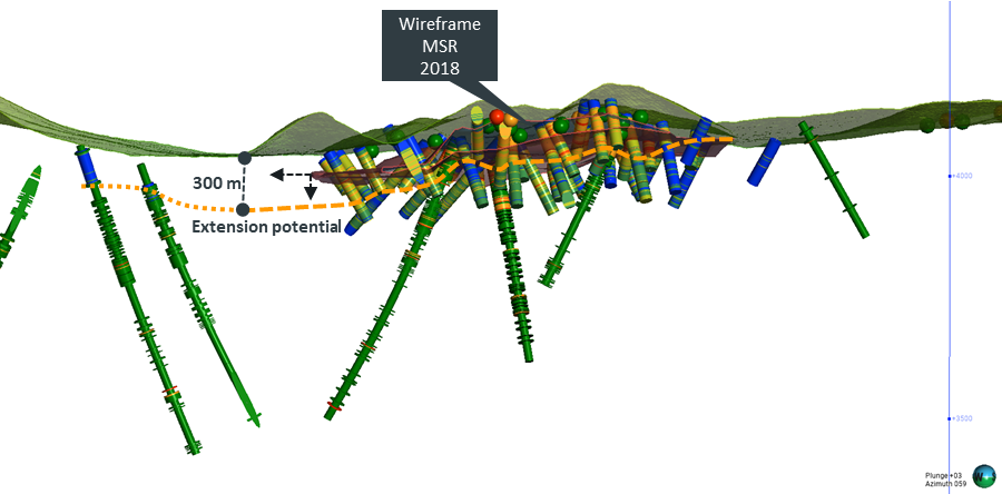
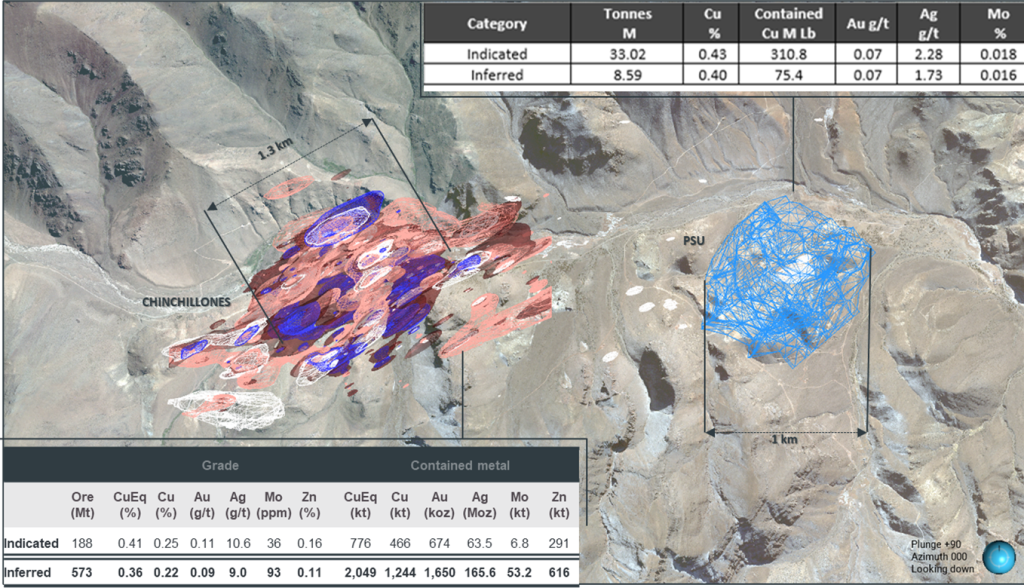
- In 2018, 43 mm t @ 0.4% Cu were estimated, with a copper price of US$2.46 / lb, and a cut law of 0.25% Cu.
- The enrichment zone is understood to be the NW.
- Mineralization was not included within the transitional domain, below the enrichment zone.
- New perforated wells, show shallow enrichment areas, which could expand the volume of the resource.
- The company is designing a stepout program to confirm in-depth extension and to the NW.
CCx:
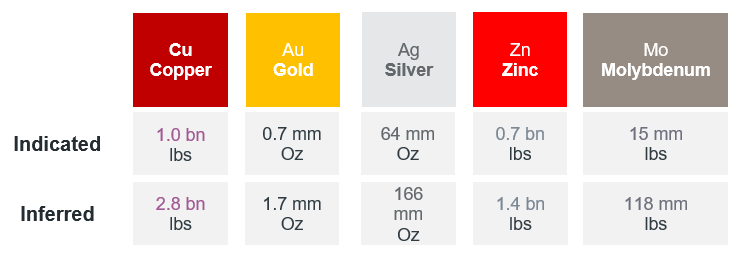
- The Chinchillones Complex - CCx, consists of an Epithermal System (HS - IS), over-imposed on several pulses of porphyte systems, with a development of mineralized gaps, which reach 700 m deep.
- Discovery and First Estimate of Mineral Resources in 5 years.
- The volumes of copper, gold and silver, as well as zinc and molybdenum, stand out
- 761 Mt MOz- Au, 229 MOz- Ag, 907 kt Zn, and h60 kt Mo. -
- It has potential for expansion over the structural corridor NE.
Location and Access
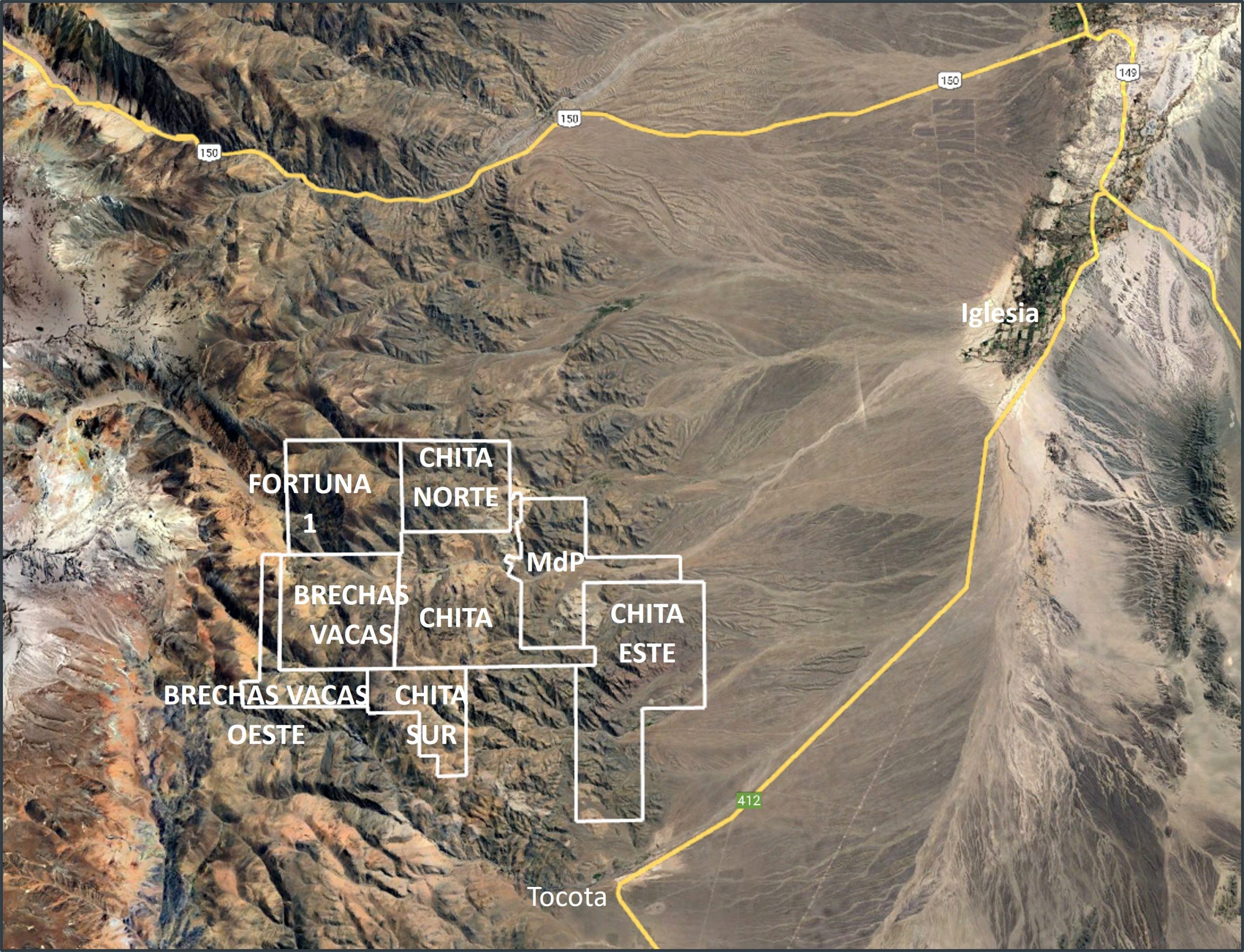
The Chita Project is located in the Chita Valley, approximately 30 km west of the town of Iglesa, in the province of San Juan, Argentina. The area is accessible through provincial routes and land roads that connect with the main communication routes of the region, allowing easy access to ports in the Pacific and Atlantic. Roads.
- Roads paved to Bella Vista 30 km from the project. 195 Km from the city of San Juan.
- Access to the Pacific Ocean through the Black Water Pass 105 km, and the Christ Redeemer Pass 430 km.
- Access to the Atlantic Ocean by rail from stations in Albardón and Cañada Honda (*), by ramal Mendoza- San Juan del Ferrocarril General San Martín.
Chronology
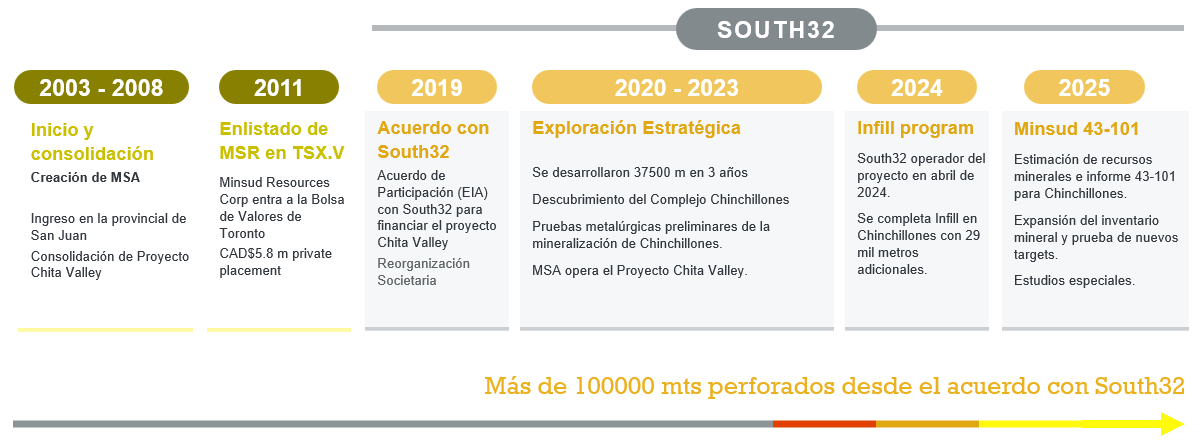
Potential
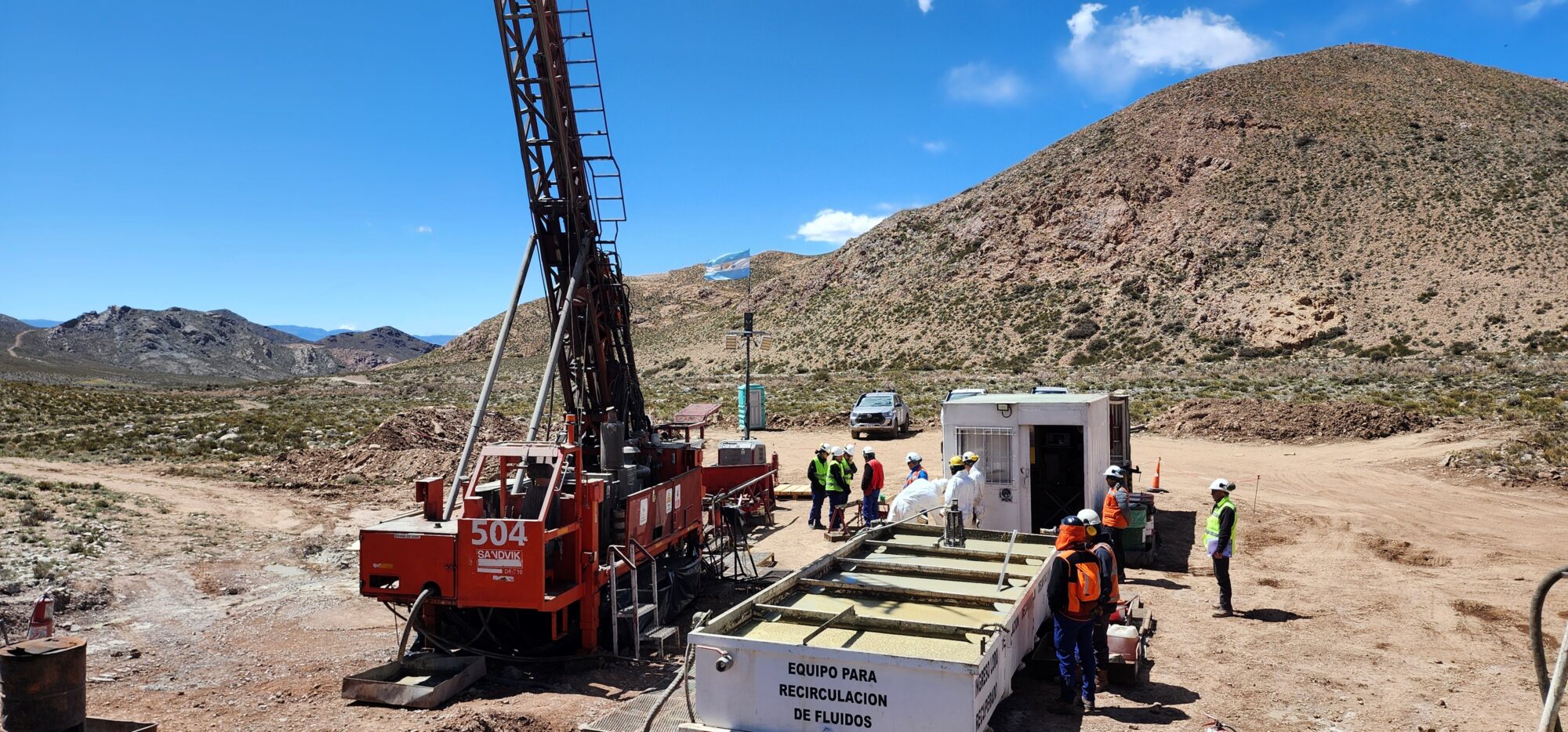
The project is located in the Departamento de Iglesia, Province of San Juan, Argentina, at an altitude of 3.000 to 3.600 metres on sea level, with a operation throughout the year.
It covers a total area of 19.951 hectares of mining concessions granted on a continuous basis.
Originally called Chita Valley, the project currently has two developed objectives, Chita and Chinchillones, both with a strong potential to expand their mineral inventory. This strategic growth drives the construction of a new name for the project, aligned with its evolution and development prospects.
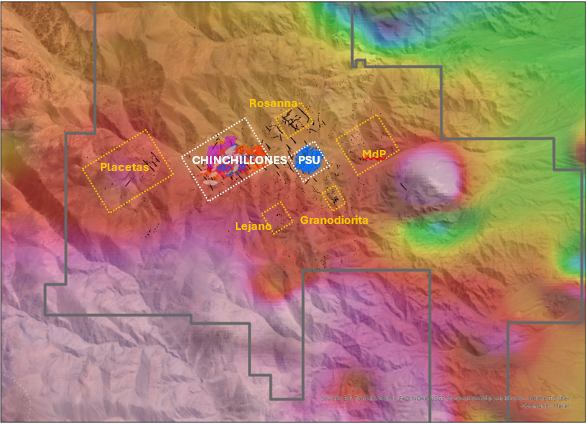
Currently the two major deposits within the property, PSU (enrichment of Cu de Chita), and the newly discovered Chinchillones complex (polymetallic) Cu, Mo, Au, Ag, Pb and Zn), associated with porphydo systems of the Miocene at the height of the Au-Cu Indio Belt (Chile). It also presents other prospective areas such as Minas de Pinto, Complex Placetas, Rosanna, Lejano and Granodiorita.
Local Geology
The area of the Chita Project is dominated by a series of intrusive granodioritic to tonalitic composition hosted in sedimentary rocks, associated with copper and molybdenum porphyde systems, and its high and intermediate epithermal systems sulpulation with zinc, lead, silver and gold. These intrusions have generated halos of hydrothermal alteration and significant mineralization in the region.
Main Litologies
- Sedimentary rocks: Rocks of the Black Water Group, which flare in the border range of the northwest of San Juan, particularly in the area of the Paso del Agua Negra, Church department. It is made up mainly of herring and pebbles, which in some sectors present thermal metamorphism, becoming hornfels, slate and filites.
- Granodioritic and Tonalithic Intrusive: They are the predominant rocks in the area, presenting textures equalular to porphyrical. These intrusives are related to the mineralization of copper and molybdenum observed in the project.
- Andesitic Volcanic Rocks: They are in less proportion and are affected by hydrothermal alteration, indicating their interaction with mineralizing fluids.
Hydrothermal disturbance
Chita and Chinchillones tanks display a typical porphyte system alteration zoning, which includes:
- Potatic impairment: Characterized by the presence of minerals such as secondary biotite and potassium feldspate, associated with the central mineralization areas.
- Physical disturbance: Dominated by sericite, quartz and pyrite, it is found in the intermediate areas and is related to the mineralization of sulphides.
- Proprietary disturbance: It is present in peripheral areas, characterized by chlorite, epidota and carbonates, indicating lower temperatures of alteration.
Mineralization
The mineralization in the Chita Project is mainly composed of:
- Copper: It is Dominantly present as a calcosine, accompanied by calcopirite and, to a lesser extent, as a bornite.
- Molybdenum: Mostly molybdenite.
- Zinc: It is presented as blender or sphalerite, and in some cases as smithsonite.
- Lead: It is mainly present as a galena along structures or vets.
- Gold and Silver: Associated with sulphides and present in variable quantities.
Control structures
Mineralization and alteration are controlled by a network of fractures and failures that have facilitated the circulation of hydrothermal fluids. These structures present predominant N-S, NE-SW, NW-SE, and E-O guidelines, influencing the distribution of mineralized areas.
Exploration and Modeling
The exploration campaigns include detailed geological mapping, surface sampling and diamantine perforations. The data obtained have allowed the construction of geological models and resources that indicate significant potential for the exploitation of copper, molybdenum, zinc, lead, gold and silver in the area.
Conclusions
The Chita Project represents a porphyte system with favourable geological characteristics for the presence of economically viable mineralization. The detailed understanding of its geology is essential for the successful development of future stages of exploration and possible exploitation.